How to Make a Crinkle Baby Toy: Easy Crinkle Square (Free Pattern)
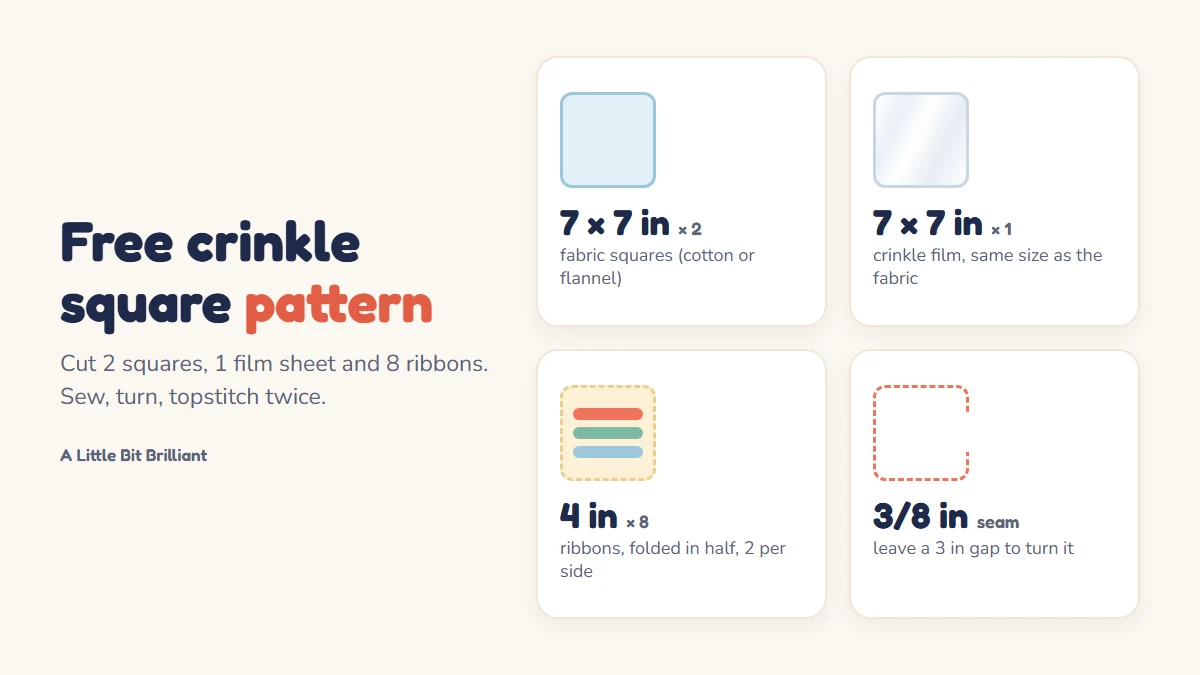
To make a crinkle baby toy, sew a sheet of crinkle film between two fabric squares, with folded ribbon loops caught in the seam. For a hand-size crinkle square, the sewing tutorials we checked use fabric squares from 6 to 8 inches, a 1/4 to 1/2 inch seam, and a 2 to 4 inch turning gap. The free pattern below uses 7 inch squares, the size three of those tutorials use. It needs no stuffing.
Below: the pattern, what to put inside, the safety rules for ribbons and decorations, how to wash it, and what changes if you want to sell them. Every source we used is listed at the end.

Download the free printable crinkle square pattern (PDF, 1 page). Print it at 100% on US Letter paper and check that the 1 inch bar measures 1 inch.
What you need
| Supply | For one toy |
|---|---|
| Fabric (cotton or flannel) | Two 7 x 7 inch squares |
| Crinkle film | One 7 x 7 inch sheet |
| Ribbon (grosgrain, satin or webbing) | Eight pieces, 4 inches each |
| Optional: flat batting | One 7 x 7 inch square, for a thicker toy |
| Tools | Sewing machine, thread, pins or clips, scissors, iron |
Why these numbers:
- 7 inch squares. Riley Blake Designs, Hello Sewing and Itchin’ for Some Stitchin’ all made theirs from 7 inch squares. Mary Meyer sells its Taggies Crinkle Me toy as a 6 x 6 inch square with 8 ribbons.
- Film the same size as the fabric. Hello Sewing cuts its crinkle layer 7 x 7 inches, the same as the fabric. Riley Blake cuts it a little smaller (6.75 inches).
- 4 inch ribbons. Hello Sewing cuts each ribbon to 4 inches. Sulky’s taggie tutorial says, “Do not use pieces longer than 4″. If the loop is bigger than that, the baby could get their little hand in and get stuck.”
- Sturdy ribbon. Sulky notes babies “will put this in their mouth,” and suggests “Grosgrain, webbing, and satin ribbons.” Itchin’ for Some Stitchin’ adds: “Just make sure that the material doesn’t fray.”
How to make a crinkle baby toy, step by step
- Wash the fabric first. Craftsy says to wash fabric “in the same manner that you plan to launder the completed” item. Flannel shrinks a lot: Nancy’s Notions suggests hot water and a hot dryer, and warns that unwashed flannel “will shrink after the project is washed,” which “causes puckers and wrinkles.”
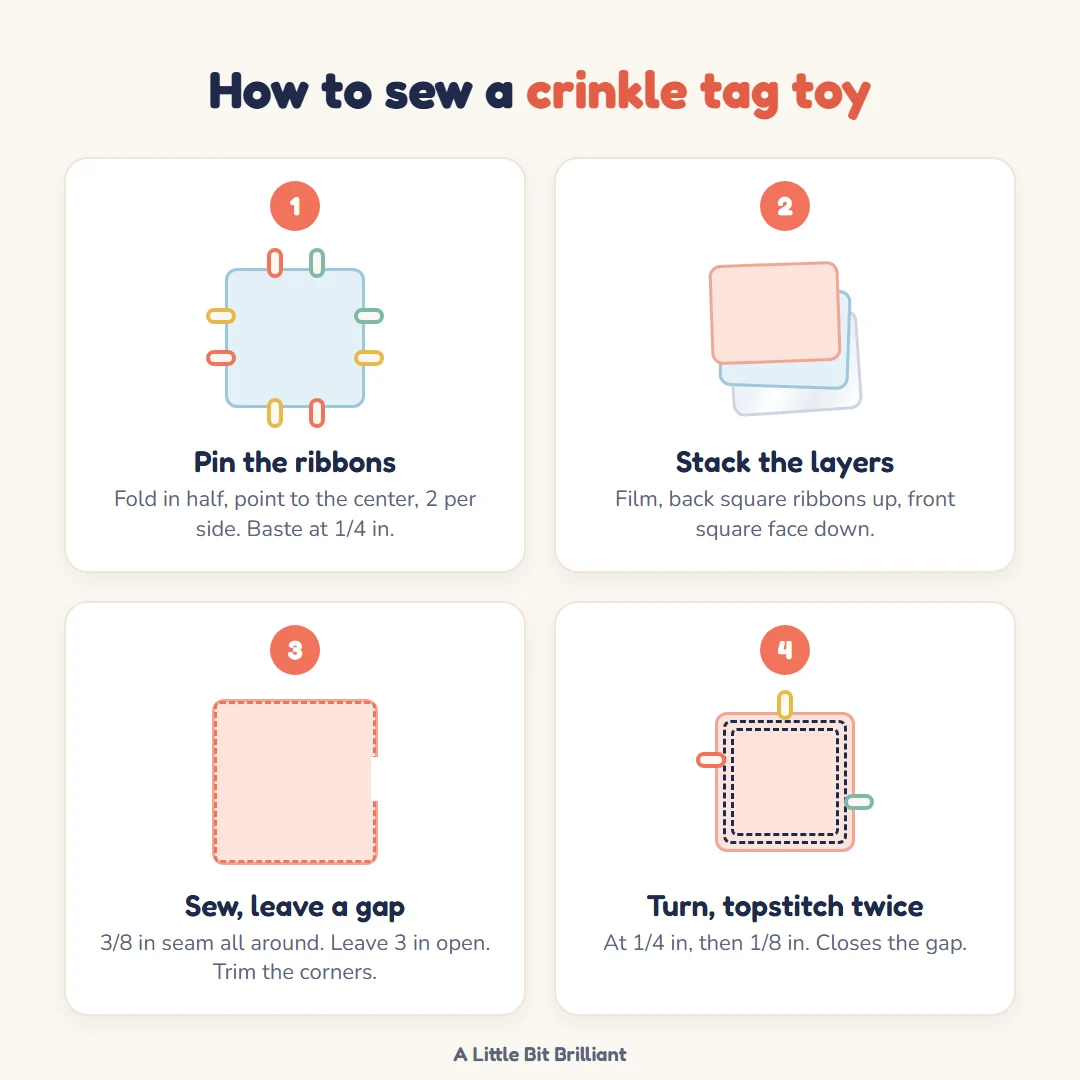
- Cut. Two 7 inch fabric squares, one 7 inch sheet of crinkle film, and eight 4 inch ribbons.
- Pin the ribbons. Fold each ribbon in half. Pin it to the right side of the back square with the fold pointing to the center and the raw ends lined up with the fabric edge. Two per side works for 8 ribbons. Keep them away from the corners. So Sew Easy says to take care “not to get too close to the corners,” and Sulky warns that ribbons too close to a corner may get sewn down when you sew the two pieces together.
- Baste the ribbons. Stitch around the edge with a 1/4 inch seam to hold the ribbons in place (Hello Sewing and Riley Blake both baste at 1/4 inch).
- Stack the layers. In Hello Sewing’s order: crinkle film on the bottom (with batting under it, if you use batting), then the back square with the ribbons facing up, then the front square face down. Riley Blake’s tip: clips help because crinkle material “can be slippy.”
- Sew around, leaving a gap. Sew all four sides with a 3/8 inch seam, leaving a 3 inch gap on one side. Backtack at both ends of the gap. Sew inside your basting line so you don’t catch the ribbons.
- Trim. Clip a small triangle off each corner, not too close to the stitching, and trim extra crinkle film close to the seam.
- Turn and press. Turn it right side out through the gap. Press the fabric but not the ribbon loops. So Sew Easy warns against “really high heat” when there is plastic inside.
- Topstitch twice. Riley Blake topstitches around the toy twice, first at 1/4 inch and then at 1/8 inch. That closes the gap and means “each ribbon has been stitched three times.” If you close the gap by hand, Sew4Home describes the whip stitch as “fast and secure,” and the ladder stitch as the invisible option.
- Check it before baby gets it. Tug every ribbon and look at every seam. The AAP’s toy advice: “Make sure all the parts are on tight and seams and edges are secure.”
Want a bigger version? So Sew Easy made 12 inch squares with 24 ribbons, and Sulky’s taggie blanket starts from an 18 inch square. The steps are the same.
What can I use for crinkle in a baby toy?
| Filler | What we found |
|---|---|
| Crinkle film sold for toys | Sold for this job. Sellers say it is machine washable (a Bosal crinkle listing: “machine washable and dryable”; American Felt & Craft: “washer, dryer and even low iron safe”). Those are the sellers’ claims. |
| A washed cereal box liner | Used in several tutorials: Tara Reed and So Sew Easy used cereal bags, Itchin’ for Some Stitchin’ used the bag from a Nilla Wafers box, and Hello Sewing lists a cereal liner as an option. Tara Reed and So Sew Easy chose cereal bags as “food grade” or “food safe” plastic. We found no safety agency that has tested or approved them for toys. Itchin’ for Some Stitchin’ says to remove “all the crumbs and any other food residue” first. |
| A chip bag | See Kate Sew says it gives “a similar sound.” No safety source covers it. |
| Balloons | No. The CPSC says “More children have suffocated on uninflated balloons and pieces of broken balloons than on any other type of toy.” |
| Grocery bags or plastic wrap | No. KidsHealth says to keep plastic bags “out of the reach of young kids,” and the CPSC says “Plastic wrappings on toys should be discarded at once before they become deadly playthings.” |
Whatever you use, it should stay sealed inside. The loose crinkle film sheet sold on Amazon by Vinspire carries the warning “CHOKING HAZARD — Small parts. Not for children under 3 yrs.” Tara Reed adds: “Don’t leave a baby unattended with anything plastic.” More on the material itself is in what is the crinkly stuff in baby toys, and supply options are in where to buy crinkle material for baby toys.
Do you need stuffing? No. Riley Blake’s supply list is just flannel, crinkle material and ribbons. If you want it thicker, Hello Sewing adds one flat layer of batting, not loose stuffing. The AAP says to avoid toys with “stuffing that can cause choking or suffocation if swallowed.”
Safety rules for homemade crinkle toys
KidsHealth says “Hand-me-down and homemade toys should be checked carefully. They may not have undergone testing for safety.” These are the points from safety sources that apply to a sewn crinkle toy.
Ribbons and loops
- No long strings. KidsHealth says a baby toy shouldn’t have “strings longer than 7 inches (18 centimeters).”
- Nothing that fits around the neck. The CPSC: “Parents should never give young children toys with cords, strings, or straps that fit around the neck.” It also knows of strangulation deaths from “necklaces, cords, or ribbons being wrapped around a child’s neck.”
- Short tag loops. Folded 4 inch ribbons make loops that stick out about 1 5/8 inches (2 inches folded, minus the 3/8 inch seam). Sulky’s 4 inch limit is about little hands getting stuck in the loop.
- Don’t add a pacifier ribbon. KidsHealth: don’t clip a pacifier “to your baby’s clothing with a ribbon or piece of string.”
- Not in the crib. The CPSC says “Never hang toys with long strings, cords, loops, or ribbons in cribs or playpens,” and the AAP says soft objects “should be kept out of the crib.”
Faces and decorations
- Embroider, don’t attach. The CPSC’s small-parts ban “includes removable small eyes and noses on stuffed toys and dolls.” KidsHealth lists “eyes, wheels, or buttons that can be pulled loose” as things to avoid. Mary Meyer’s crinkle square uses “All embroidered details for safety and durability.”
- No magnets or button batteries. The CPSC says small magnets “can kill children if two or more are swallowed,” and the AAP warns about “small batteries (button or lithium coin) or high-powered magnets.”
- Teethers. If you add a teether to a ribbon, Riley Blake says to use one that “has passed the relevant safety standard tests in your region.”
Keep checking it
KidsHealth says to check toys “often for loose or broken parts.” The CPSC’s long-standing advice: “A toy that cannot be repaired should be thrown away immediately.”
How to wash a homemade crinkle toy
| Source | What it says |
|---|---|
| Mary Meyer (toys with crinkle paper) | “Place your toy in a mesh bag or clean pillowcase.” “Wash in cold water on the delicate cycle.” “Lay all toys flat to air dry.” |
| Tara Reed (her own test, one toy) | Cold wash, dryer on medium “for about 15 minutes,” then air dry. “The cereal bag plastic held up well!” |
| CDC (cloth toys in child care) | “Launder items (if possible) according to the manufacturer’s instructions.” “Use the warmest appropriate water setting and dry items completely.” |
| CDC (anything that goes in the mouth) | “Sanitize surfaces that come in contact with children’s mouths, such as infant feeding items and toys.” For cloth items, the CDC’s method is the washing machine: “Sanitize fabric articles by machine-washing and drying them after each use.” |
For a toy you made, the care you can follow is your fabric’s and your crinkle film’s.
If you plan to sell crinkle toys
Selling a crinkle toy in the US brings federal children’s product rules:
- Testing and a certificate. The CPSC says that “In general, all manufacturers and importers of children’s products must have their products third-party tested at a CPSC-accepted laboratory and certified as compliant in a Children’s Product Certificate (CPC).” Writing the CPC “has no cost,” and it is required even when you sell directly to buyers.
- Small Batch relief, with limits. Small makers that register with the CPSC as Small Batch Manufacturers can get relief from some third-party tests. The CPSC Small Batch page lists the limits as $1,436,864 or less in total gross revenue from all consumer products in the prior calendar year, and no more than 7,500 units of the product made that year. The CPSC’s SaferProducts.gov registration FAQ uses a newer figure, $1,480,296 in 2026 revenue to qualify for 2027, so check before you register. Registration is valid for the current calendar year only, and firms “must recertify every year.”
- The rules still apply. Small Batch status only changes how some tests are done. The CPSC says registered Small Batch Manufacturers “must still comply with all applicable CPSC product safety requirements,” and the toy standard (ASTM F963) is on its Group B list.
- Small parts testing is never waived. The small parts rule (16 CFR 1501) is in Group A, and “Testing to the Group A requirements must always be conducted by a third-party, CPSC-accepted laboratory.”
- Tracking labels. The CPSC: “There is no exemption or exception from the tracking label requirement based on the size of the business.” The label lists who made it and where and when it was made, plus a batch number or similar.
FAQ
How big should a crinkle square be?
For a hand-size crinkle square, the tutorials we checked use 6 to 8 inch fabric squares. Our pattern uses 7 inch squares, which come out about 6 1/4 inches after a 3/8 inch seam. Mary Meyer's crinkle square is 6 x 6 inches.
How long should taggie ribbons be?
Cut them 4 inches long and fold them in half. Sulky says not to use pieces longer than 4 inches so a baby's hand can't get stuck in the loop. Hello Sewing also cuts 4 inch pieces.
What can I use for crinkle in baby toys?
Crinkle film sold for toys, or what several tutorials use: a washed cereal box liner. No safety agency we found has tested cereal bags for toys. Never use balloons.
Is a chip bag safe inside a crinkle toy?
We found no safety source that says either way. See Kate Sew says a chip bag gives a similar sound. If you use any food bag, clean out all crumbs, and keep it fully sewn in.
Do you put stuffing in a crinkle toy?
No. A crinkle square is just fabric, crinkle film and ribbons. You can add one flat layer of batting for thickness.
Can you wash a homemade crinkle toy?
Yes, if your fabric and filler can be washed. Mary Meyer's care instructions for toys with crinkle paper say to wash them in a mesh bag, in cold water on the delicate cycle, and lay them flat to dry.
Can I sell homemade crinkle toys?
Yes, but US federal rules apply. The CPSC requires a Children's Product Certificate and a tracking label even for small makers, and small parts testing must always be done by a CPSC-accepted lab. Other rules, such as the toy standard ASTM F963, still apply too; registered Small Batch Manufacturers may be able to show those another way.
Sources
- CPSC: For Kids’ Sake: Think Toy Safety, Strings and Straps on Toys Can Strangle Young Children, Ingested Magnets, Small Batch Manufacturers and Third Party Testing, Children’s Product Certificate FAQ, Tracking Label FAQ, SaferProducts.gov Small Batch FAQ, Holiday Toy Safety Campaign (1982)
- CDC: How To Clean and Disinfect Early Care and Education Settings
- American Academy of Pediatrics, HealthyChildren.org: How to Buy Safe Toys
- Nemours KidsHealth: Choosing Safe Toys for Babies, Preventing Strangulation and Entrapment, Preventing Suffocation
- Mary Meyer: Taggies Crinkle Me Peepers Frog and care instructions
- Sewing tutorials: Riley Blake Designs, Riley Blake Designs (tummy time post), Hello Sewing, Itchin’ for Some Stitchin’, So Sew Easy, Sulky, Tara Reed Designs, See Kate Sew, Sew4Home
- Fabric prep: Craftsy, Nancy’s Notions
- Seller pages (seller claims, not independently verified): Vinspire crinkle paper, American Felt & Craft, Bosal crinkle material
This guide is general information for parents and caregivers who sew. Always supervise babies with homemade toys.