When Do Babies Start Playing With Toys? (A Month-by-Month Guide)
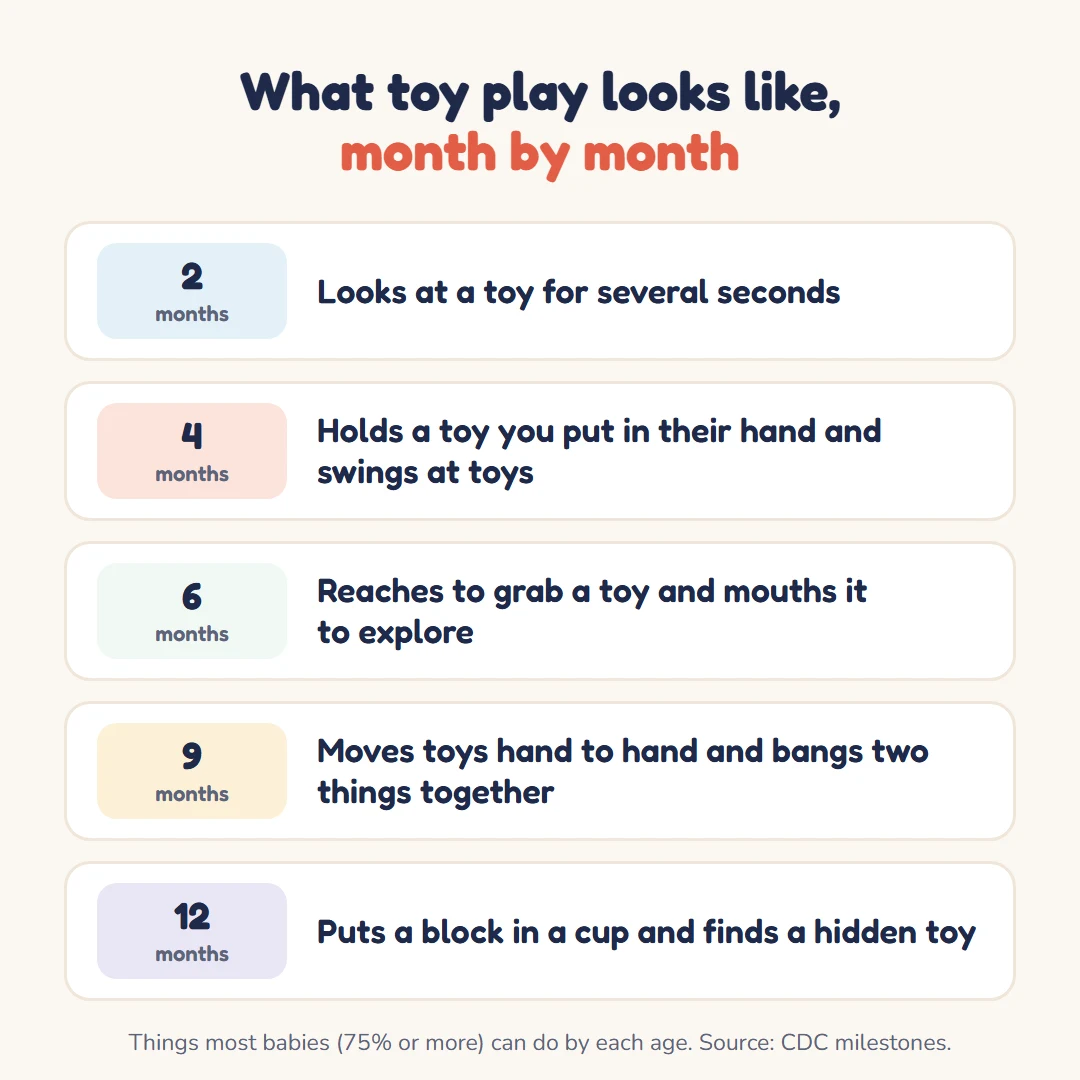
Babies start playing with toys in small ways within the first two months. By 2 months, most babies look at a toy for several seconds. By 4 months, most hold a toy when you put it in their hand and swing their arm at toys. By 6 months, most reach to grab a toy they want and put things in their mouth to explore them. These are CDC milestones, which the CDC defines as things most children (75% or more) can do by a certain age.
Below: what play looks like at 2, 4, 6, 9 and 12 months, which simple toys fit each stage, the safety rules that matter for babies, and when to talk to your baby’s doctor. Our sources are listed at the end.

Play by age at a glance
| Age | What most babies do (CDC) | Simple ways to play |
|---|---|---|
| 2 months | “Looks at a toy for several seconds” and “Opens hands briefly” | Toys at eye level during tummy time, a rattle shaken to one side, a baby-safe mirror |
| 4 months | “Holds a toy when you put it in his hand,” “Uses his arm to swing at toys,” “Brings hands to mouth” | Easy-to-hold toys such as rattles or cloth books with colorful pictures |
| 6 months | “Reaches to grab a toy she wants” and “Puts things in her mouth to explore them” | Toys just out of reach so your baby rolls to get them, floor or play mat time every day |
| 9 months | “Moves things from one hand to her other hand,” “Bangs two things together,” looks for dropped objects | Dumping blocks out of a container and putting them back, passing a toy back and forth, peek-a-boo |
| 12 months | “Puts something in a container, like a block in a cup,” “Looks for things he sees you hide” | Pots and pans, a small drum, blocks, games like pat-a-cake |
Newborn to 2 months: looking is playing
The American Academy of Pediatrics (AAP) says that in the early weeks a baby “can see light, shapes and faces,” and that a newborn sees best at “about 8 to 12 inches (20 to 30 cm) away.” In the second month, the AAP says a baby’s hands “will likely still be clenched in tight little fists.”
By 2 months, the CDC lists “Looks at a toy for several seconds” and “Watches you as you move.” The CDC’s play tips for this age:
- “Lay your baby on his tummy when he is awake and put toys at eye level in front of him.”
- “Hold a rattle off to one side of your baby’s head, shake it, and see if your baby looks for the noise.”
- “Place a baby-safe mirror near your baby so she can look at herself.”
Zero to Three puts it simply: “You don’t need toys to play with babies this young!”
3 to 4 months: holding and swiping
This is when babies start to hold toys. By the third month, the AAP says hands “will no longer be balled up in fists all the time,” and a baby “may even be able to hold and shake hand toys.” Babies this age “may begin to swipe at objects hanging just out of reach.”
By 4 months, the CDC lists “Holds a toy when you put it in his hand,” “Uses his arm to swing at toys” and “Brings hands to mouth.” MedlinePlus (from the U.S. National Library of Medicine) adds that a 4-month-old may “Play with a rattle when it’s placed in their hands, but won’t be able to pick it up if dropped.”
The CDC suggests safe toys “that are easy to hold, like rattles or cloth books with colorful pictures for her age,” and safe chances to “reach for toys, kick at toys.”
6 months: reaching, grabbing and mouthing
By 6 months, the CDC lists “Reaches to grab a toy she wants” and “Puts things in her mouth to explore them.” Many parents ask when babies start playing with toys instead of eating them. Mouthing is part of play at this age: the CDC counts it as a milestone, and the AAP’s play report says to “Let your infant bring safe objects to his or her mouth to explore and experience new textures.” That also means the toys within reach should be safe for your baby to mouth (see our guide to cleaning baby toys that go in the mouth).
CDC tips for 6 months:
- “Put your baby on her tummy or back and put toys just out of reach. Encourage her to roll over to reach the toys.”
- “When he drops a toy on the floor, pick it up and give it back. This game helps him learn cause and effect.”
- “Playing on the floor or play mat with your baby every day helps him to move, learn, and explore.”
The AAP adds that from “the sixth to eighth month, they’ll learn to transfer objects from hand to hand, and turn and twist them.”
9 months: banging, dropping and peek-a-boo
By 9 months, the CDC lists “Moves things from one hand to her other hand,” “Bangs two things together,” “Looks for objects when dropped out of sight (like his spoon or toy)” and “Smiles or laughs when you play peek-a-boo.” The AAP says the pincer grasp with index finger and thumb comes at “about nine months old.”
CDC play ideas for this age: “Play with your baby by dumping blocks from a container and putting them back in together,” and “Make it a game when your baby drops things. Hand the item back to her so she can drop it again.”
12 months: putting in, finding and simple games
By 1 year, the CDC lists “Puts something in a container, like a block in a cup,” “Looks for things he sees you hide, like a toy under a blanket” and “Plays games with you, like pat-a-cake.” Its tips: “Give your baby pots and pans or a small musical instrument like a drum or cymbals,” and “Play together with blocks and other toys that encourage your baby to use her hands.”
The best toys are simple ones you play with together
You don’t need a pile of toys. The AAP’s 2018 report on play says creativity and play are helped by “many inexpensive toys (eg, wooden spoons, blocks, balls, puzzles, crayons, boxes, and simple available household objects) and by parents who engage with their children.” An AAP toy report (Healey and Mendelsohn) found that “the best toys for children’s development are those that foster play between a caregiver and child,” and that “Electronic toys by themselves do not provide children with the interaction and parental engagement.”
Tummy time is where the CDC’s first toy tip starts. The AAP says you can start “the day your baby gets home from the hospital,” play with your baby on their tummy “2 to 3 times each day,” and “Work up to 15 to 30 minutes each day by 7 weeks.” It also suggests you “Place toys in a circle around the baby.” Tummy time is only for babies “who are awake and being closely supervised.” (If you’re thinking about a water play mat, see our guide to choosing a tummy time water mat.)
Toy safety rules for babies
Babies explore with their mouths, so these CPSC and AAP rules are worth knowing:
- No small parts under age 3. Federal rules ban small parts in toys meant for children under 3. A toy fails if it fits entirely inside a test cylinder, which a 1979 CPSC notice describes as “1-1/4 inches in diameter by 2-1/4 inches in depth.” The CPSC also says the ban “includes removable small eyes and noses on stuffed toys and dolls, and small, removable squeakers on squeeze toys.”
- Rattles have their own rule. The CPSC says a rattle must “be designed and constructed so that it cannot enter an infant’s mouth and block his or her throat.”
- Take crib gyms down early. The CPSC says to “Remove crib gyms from the crib when the child can pull up on hands and knees,” and to “Never hang toys with long strings, cords, loops, or ribbons in cribs or playpens.”
- Watch for button batteries and strong magnets. The CPSC warns that a swallowed button battery “can burn through a child’s throat or esophagus in as little as two hours,” and that toys with these batteries must have a closure “requiring a screwdriver, coin or tool to open.” If you think your child swallowed one, it says to “immediately seek medical attention” and call the National Battery Ingestion Hotline (800-498-8666) or the Poison Help Line (800-222-1222). The AAP says to “Avoid toys with button batteries or high-powered magnets.”
- Check the age label and older siblings’ toys. The AAP says to “Follow the age recommendations on toy packages,” and the CPSC reminds families that older children’s toys “can harm the younger siblings.”
- Keep balloons away. The CPSC says “More children have suffocated on uninflated balloons and pieces of broken balloons than on any other type of toy.”
When to talk to your baby’s doctor
Milestones describe what most babies (75% or more) can do by an age, not every baby. The CDC’s advice: “If your child is not meeting one or more milestones, has lost skills he or she once had, or you have other concerns, act early.” It says to “Talk with your child’s doctor, share your concerns, and ask about developmental screening,” and adds, “You know your child best. Don’t wait.”
FAQ
Can a 2 month old play with toys?
Yes, in a simple way. The CDC lists "Looks at a toy for several seconds" as a 2-month milestone and suggests putting toys at eye level during tummy time.
When do babies start grabbing toys?
MedlinePlus says infants begin "grabbing for objects at 3 to 5 months." By 6 months, the CDC lists "Reaches to grab a toy she wants."
When do babies start reaching for toys?
Around 3 to 4 months, babies swipe at toys, and the CDC lists "Uses his arm to swing at toys" at 4 months. By 6 months, most reach to grab a toy they want.
When can I give my baby a rattle?
The CDC suggests shaking a rattle to one side of a 2-month-old's head to see if they look for the sound. By 4 months, the CDC suggests easy-to-hold toys like rattles, and MedlinePlus says a 4-month-old may play with a rattle placed in their hands.
When do babies start playing with toys instead of eating them?
Mouthing is normal play for babies. The CDC lists "Puts things in her mouth to explore them" as a 6-month milestone. By 9 to 12 months, the CDC lists other kinds of toy play, such as banging two things together and putting a block in a cup.
When do newborns start playing with toys?
In the first weeks, babies mostly look. The AAP says newborns see best at about 8 to 12 inches away, and the CDC lists looking at a toy for several seconds by 2 months.
Sources
- CDC, Milestones by 2 Months: cdc.gov/act-early/milestones/2-months.html
- CDC, Milestones by 4 Months: cdc.gov/act-early/milestones/4-months.html
- CDC, Milestones by 6 Months: cdc.gov/act-early/milestones/6-months.html
- CDC, Milestones by 9 Months: cdc.gov/act-early/milestones/9-months.html
- CDC, Milestones by 1 Year: cdc.gov/act-early/milestones/1-year.html
- AAP HealthyChildren, Baby’s Vision Development: healthychildren.org
- AAP HealthyChildren, Movement: Birth to 3 Months: healthychildren.org
- AAP HealthyChildren, Movement: 4 to 7 Months: healthychildren.org
- AAP HealthyChildren, Back to Sleep, Tummy to Play: healthychildren.org
- AAP HealthyChildren, Best Toys Go Back to the Basics: healthychildren.org
- AAP HealthyChildren, What to Look for in a Toy: healthychildren.org
- AAP HealthyChildren, Choking Prevention: healthychildren.org
- Yogman M, et al. The Power of Play. Pediatrics. 2018;142(3):e20182058: doi.org/10.1542/peds.2018-2058 (PDF copy)
- MedlinePlus, Infant – newborn development: medlineplus.gov
- MedlinePlus, Developmental milestones record – 4 months: medlineplus.gov
- Zero to Three, Let’s Play: zerotothree.org
- eCFR, 16 CFR 1501.4 (small parts test): ecfr.gov
- CPSC, Rules to Reduce Childhood Chokings Proposed (1979): cpsc.gov
- CPSC, Rattles business guidance: cpsc.gov
- CPSC, For Kids’ Sake (Pub. 281): cpsc.gov PDF
- CPSC, Button Cell / Coin Battery Information Center: cpsc.gov
- CPSC, Holiday Shopping Safety Tips (2023): cpsc.gov
Sit on the floor, hand your baby one simple toy, and play together. The AAP says the best toys are those that foster play between a caregiver and child.