How to Clean Baby Play Mat: Foam Tiles, Fabric Mats and Play Gyms
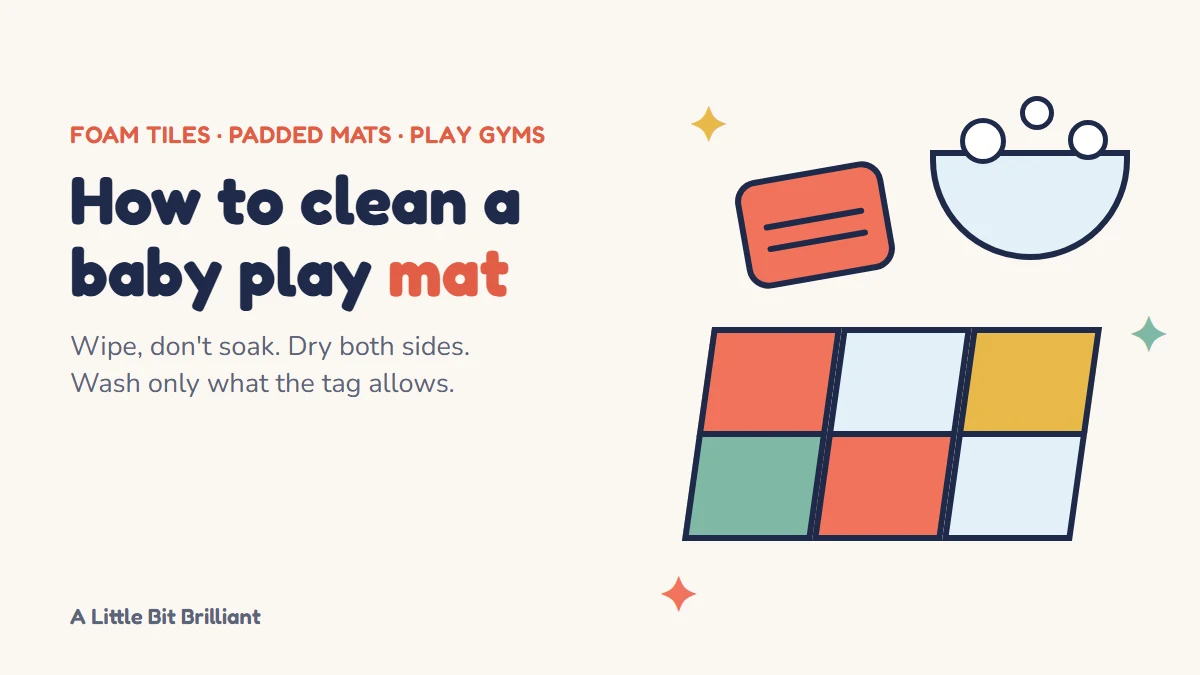
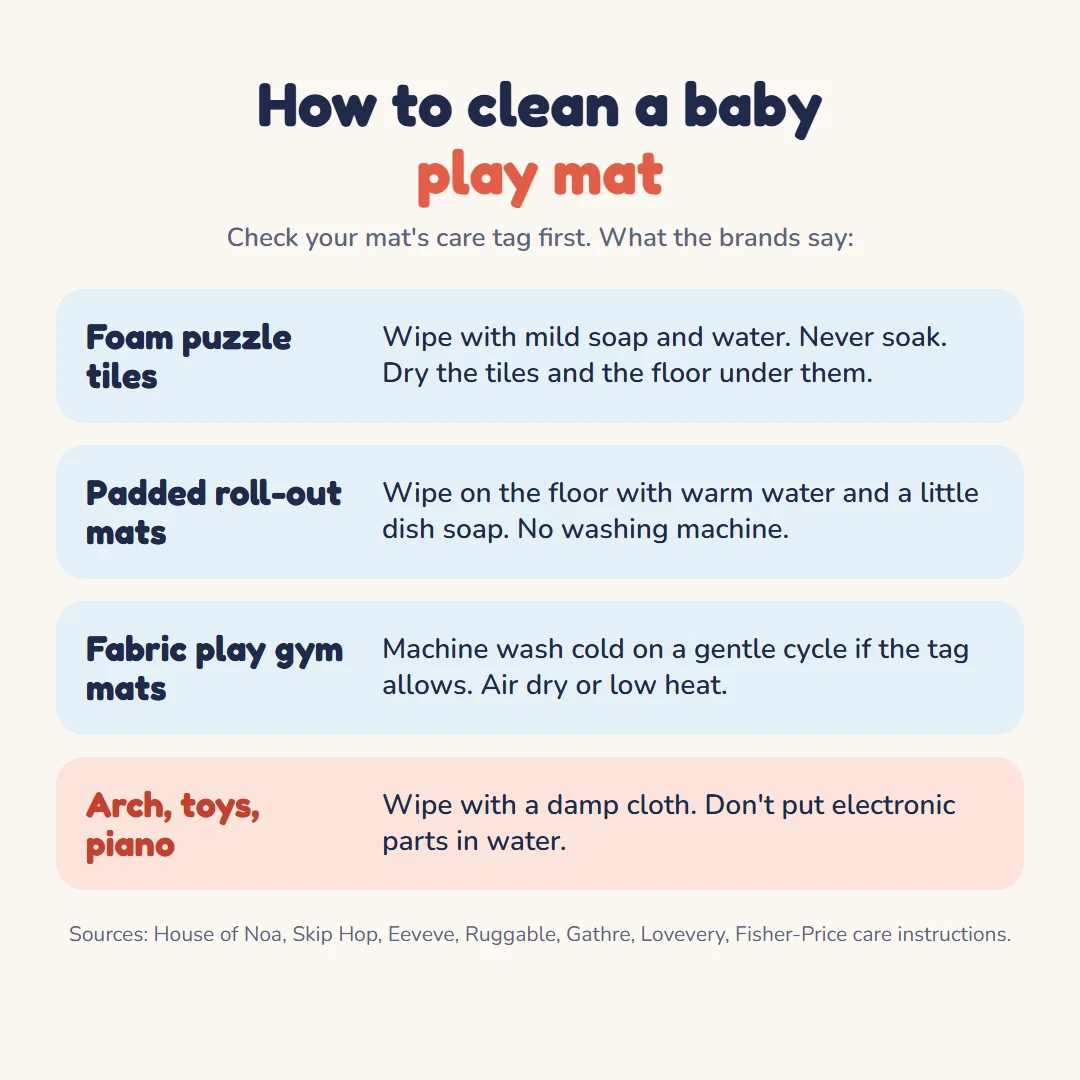
How to clean a baby play mat depends on what it’s made of. Foam puzzle tiles and padded roll-out mats are wipe-only: use a soft cloth with mild dish soap and water, wipe off the soap with a damp cloth, never soak them, and let them dry completely on both sides before you put them back on the floor. Fabric play gym mats can often go in the washing machine if the tag says so: Lovevery and Fisher-Price both say cold water on a gentle or delicate cycle, and Fisher-Price adds “Do not use bleach.” The arches, hard toys and anything with batteries get wiped with a damp cloth, not washed.
Below: a quick table by mat type, step-by-step cleaning for foam tiles, padded mats and play gyms, whether you need to disinfect, what to do after vomit or a diaper blowout, how often to clean, how to keep mold out, and when a mat should go. Every brand rule is quoted from that brand’s own care page or instruction sheet, and our sources are listed at the end.
Popular baby play mats on Amazon
Top sellers in Amazon’s Baby Gyms & Playmats category on Nov. 18, 2026 (water mats skipped).


As an Amazon Associate, we earn from qualifying purchases. Rankings change often.
How to clean a baby play mat: quick answer by type
| Mat type | How to clean it | Avoid |
|---|---|---|
| Foam puzzle tiles | Wipe with a cloth, mild soap and water, then dry the tiles completely (House of Noa, Skip Hop, Eeveve) | Soaking, lots of water, floor cleaner, acetone, alcohol |
| Padded roll-out or foldable mats | Wipe with warm water and a few drops of mild dish soap, wipe off the residue, dry both sides (Ruggable, Tumble, Gathre) | Soaking, machine washing (Gathre), “magic eraser” sponges, alcohol-based cleaners |
| Fabric play gym mats | Machine wash cold on a gentle or delicate cycle, air dry or low heat (Lovevery, Fisher-Price) | Bleach (Fisher-Price), washing the arch or piano |
| Water-filled tummy time mats | Before first use, clean with a damp cloth and mild soap, then air dry (Baby Einstein) | See our tummy time water mat guide |
If your mat came with a care tag or instruction sheet, follow it first. The brands on this page don’t all agree, so the rules below are what each brand says for its own mats.
How to clean foam puzzle mat tiles
Foam (EVA) interlocking tiles are wipe-only. Skip Hop’s care note for its EVA foam floor tiles is short: “Wipe clean with wet cloth and mild soap.” House of Noa, which makes Little Nomad mats, gives the most detail:
- Wipe up spills right away. House of Noa says, “Wipe up smaller spills right away with a dry cloth.”
- Wipe the tiles with soap and water. “Use a sponge or cloth with mild soap and water.” Before first use, House of Noa says to wipe “the face and the back of the mats” with either a light dish soap solution or a light white vinegar and water solution.
- Wipe off the soap. For that first cleaning, House of Noa says, “If using a dish soap cleaning solution, be sure to thoroughly wipe the mats with a damp cloth afterwards!”
- Don’t soak them. “Do not soak play mat tiles or use large amounts of water or cleaning solution on your mat.” Eeveve, which sells a puzzle-piece playmat with a printed top, says to “never soak the mat,” because “This can cause the top layer to loosen over time.”
- Dry the tiles and the floor under them. House of Noa says to dry your mat completely “so you don’t allow any moisture to get trapped underneath,” and to “clean and dry the area completely before placing your mat back on the floor.” Before first use, it says to let the separated tiles dry “in a well-ventilated area for 24 hours.”
House of Noa asks parents to “refrain from using abrasive cleaning solutions like window cleaner, floor cleaner, acetone or alcohol,” and says, “Please do not clean your mat with a power vacuum.” Eeveve says “Do not use baby wipes” and “Avoid all-purpose or household cleaners.”
We didn’t find any foam tile brand that says its tiles can go in a dishwasher or washing machine.
How to clean a padded roll-out or foldable play mat
Ruggable, Tumble and Gathre all say their roll-out mats are wiped clean, not washed. Ruggable says its play mat “wipes clean on the floor in minutes using just warm water, mild dish soap, and a soft cloth—no machine washing needed.” Its steps:
- Every day, clear crumbs. “Shake out crumbs and clear loose debris with a dry cloth or a soft-bristled brush.” Ruggable says you can vacuum “as long as the brushroll is turned off,” but to avoid robot vacuums.
- Wipe it. “Wipe the surface clean with a soft, wet cloth. For heavier messes, mix a few drops of mild dish soap into warm water and work the solution across the surface in gentle circular motions.”
- Wipe off the residue and dry it. “Wipe away residue with a clean, damp cloth, then dry thoroughly.”
- Clean under it now and then. Lift the mat, vacuum or mop the floor, wipe the underside, and make sure “both the mat and the floor are completely dry before laying it back down.”
For stubborn stains, Ruggable suggests a paste of “3 parts baking soda to 1 part water,” left for 60 seconds and wiped off. It warns that “magic eraser” style sponges “can wear the surface” and to avoid “acetone, nail polish remover, and alcohol-based cleaners.”
Tumble says its play mats “are water resistant, but are not designed to be soaked or saturated.” Gathre, which makes bonded leather mats, says “Do not machine wash or iron.”
UK brand Totter + Tumble says not to use “stain specific cleaners or bleach,” and lists sprays with “citric acid and hypochlorous acid or any alcohols” as ones that “could have a bleaching or cracking effect on our playmats.” If you use a “baby-safe” spray, check that your mat’s brand allows it.
How to clean a baby play gym
A play gym has two parts: the soft mat and the arch with its toys. They’re cleaned differently.
Lovevery The Play Gym: “The Activity Mat is machine washable on the delicate cycle in cold water. Before laundering, remove any detachable accessories and close all velcro loops.” Lovevery says you can machine dry it “on low or no heat, but we recommend that you air dry it for best results.” If your mat has squeakers inside, Lovevery says to “press the squeakers several times as the mat dries to remove any excess water.” The other parts of the gym “can be wiped clean with a damp cloth as needed.”
Fisher-Price Deluxe Kick & Play Piano Gym: “The mat and soft toy are machine washable. Wash separately in cold water on the gentle cycle. Do not use bleach. Tumble dry on low heat.” And: “The arch, hard toys, mirror, bases and piano can be wiped with a clean, damp cloth. Do not immerse the piano.”
For other play gyms, look for the care tag sewn into the mat. If you’re not sure, wipe the hard parts and the electronic parts with a damp cloth, and wash only what the tag says can be washed.
Do you need to disinfect a baby play mat?
Usually not. Cleaning and disinfecting aren’t the same thing. Soap and water clean dirt off, and a disinfectant is a product that kills germs. When Consumer Reports asked the American Academy of Pediatrics about toys, pediatrician Danette Swanson Glassy, MD, said that unless someone sick with fever or diarrhea touches your children’s toys, “at home, cleaning is enough.” In the Head Start cleaning schedule for child care programs, floors are cleaned daily, and the schedule says to “Disinfect if soiled with body fluids.”
The brands don’t agree on disinfectants:
- Lovevery: “We do not recommend sanitizing any of our products.”
- Ruggable, when needed: “Use a non-bleach disinfectant. Wipe the surface, follow with a clean damp cloth, and dry.”
- Gathre: “Clorox wipes are great for sanitizing.” The EPA-stamped label for Clorox Disinfecting Wipes includes a line that says, “For toys, rinse with water after wiping with -or- using the product.”
- Eeveve: “Avoid all-purpose or household cleaners.”
Vinegar isn’t a disinfectant. A UCSF child care health handout says that baking soda, vinegar and borax “can be used to clean dirt from surfaces,” but “they do not kill germs well enough to be sanitizers.” House of Noa offers a light vinegar and water solution as a cleaner, which is fine for cleaning. For killing germs, the same handout says, “Only products with EPA registration numbers on the label can claim they kill germs.” More in our guides to cleaning baby toys with vinegar and what to disinfect baby toys with.
Skip alcohol on coated mats. In December 2024, Health Canada recalled a FLAGAV printed play mat, warning that “Frequent use of detergents containing alcohol and chemical ingredients can cause the coating to peel off in small parts which may pose a choking hazard for young children.”
How to clean a play mat after vomit, poop or a diaper blowout
This is when disinfecting matters. Norovirus spreads when tiny particles of vomit or poop from a sick person get into someone’s mouth, the CDC says. The CDC’s norovirus steps are written for surfaces in general, not play mats, so check your mat’s care rules too.
- Put on gloves and pick up the mess. The CDC says to “wipe the entire area with paper towels and throw them in a plastic trash bag.” University of Minnesota Extension adds that you can “Scrape up vomit or stool with paper plates or cardboard.”
- Clean with soapy water. UMN Extension says to clean the surface “with disposable cloths and a soapy water or detergent solution” before disinfecting.
- Disinfect. The CDC says to use “a chlorine bleach solution with a concentration of 1,000 to 5,000 ppm (5 to 25 tablespoons of household bleach [5% to 8%] per gallon of water) or use an EPA-registered disinfecting product against norovirus,” and to leave bleach on “for at least 5 minutes.” Many mat brands say no bleach, so for those mats, the other option is a product from the EPA’s norovirus list (List G). Check that its label has directions for norovirus, and follow its label.
- Clean again. The CDC’s last step: “Clean the entire area again with soap and hot water.” Then dry the mat and the floor under it.
For a fabric play gym mat, washing is the practical option. For clothes or linens with vomit or poop on them, the CDC’s norovirus advice is to wash them with detergent and hot water on the longest cycle, then machine dry on the highest heat, but your play gym’s tag may say cold water and low heat. If the tag and the CDC don’t match, ask the brand before you wash it hot.
How often to clean baby play mat surfaces
There’s no official home schedule. We didn’t find a CDC, EPA, CPSC or AAP page with a cleaning interval for a home play mat. For toys in general, Dr. Glassy told Consumer Reports: “As needed, and once per week is reasonable advice, but there is no evidence (no studies done) that show this is necessary.”
What the brands say:
- Ruggable: clear crumbs daily, wipe as routine upkeep, disinfect “As Needed.”
- Gathre: “Clean the mat promptly after use with wet rag and soapy water.”
- Eeveve: “Clean only when needed and always use a slightly damp cloth.”
- Lovevery: the play gym’s other parts can be wiped “as needed.”
Child care programs follow stricter rules than homes. The Head Start schedule says to clean floors daily, and to clean sleeping “Cribs, cots, and mats” used by one child “After each use and weekly.” Those are nap mats, not play mats, but it’s a useful benchmark. For more, see how often to clean baby toys.
How to keep mold out of a play mat
What the brands warn about most is water trapped under the mat. Eeveve says, “Trapped moisture can lead to discoloration or mold on both the mat and the floor.” Gathre says to “allow the mat to dry completely before putting it away to prevent any unwanted mold.”
- Use a damp cloth, not a soaking one.
- Dry both sides, and dry the floor under the mat.
- Take foam tiles apart now and then to clean the floor and the tile edges.
- Store mats dry. Eeveve says, “Always keep the mat in a dry environment.”
The EPA’s home mold guide says that “If wet or damp materials or areas are dried 24-48 hours after a leak or spill happens, in most cases mold will not grow.”
About drying in the sun: Eeveve says “Avoid direct sunlight” because “Prolonged exposure may cause the print to fade,” while Totter + Tumble says sunshine “is also a natural stain aid.” Follow your own mat’s brand.
New foam mat smell and formamide
In 2010, foam puzzle mats in France were found to release formamide, a chemical the EU classifies as toxic to reproduction. France suspended sales of these mats at the end of 2010. The EU later set a limit on formamide emissions from foam toy materials for toys meant for children under 3, which has applied since May 24, 2017. We didn’t find a US formamide limit for play mats.
In a 2011 report, the French agency ANSES said emissions from the three puzzle mats it looked at dropped quickly over the first few days. Its advice: “Consumers should unpack new puzzle mats and keep them for several days in a room not frequented by the child, before using them.” Joe Schwarcz, PhD, of McGill University’s Office for Science and Society, wrote in 2017 that the amounts children could inhale are “way below levels that could cause health issues.”
So for a new foam mat, unpack it, wipe and dry the tiles, and let it air out in a room your baby isn’t using for a few days.
When to replace a baby play mat
Replace a mat that’s breaking into small pieces. In 2009, Health Canada recalled three sets of foam puzzle mats with pop-out letters and numbers because they “can break into small parts, posing a choking hazard to young children under 3 years of age.” A Canadian health unit’s child care guidance says, “Floor mats that cannot be adequately cleaned and disinfected should be promptly removed and replaced.”
We didn’t find a brand rule on exactly when to replace cracked or crumbling tiles. Check the mat when you clean it, and remove any tile that’s tearing, crumbling or losing its top layer.
For the toys that live on the mat, see our full guide to how to clean baby toys.
FAQ
Can you put a baby play mat in the washing machine?
Only if it's a fabric mat and the tag says so. Lovevery and Fisher-Price fabric play gym mats are machine washable in cold water on a gentle or delicate cycle. Foam tiles and padded roll-out mats are wiped clean instead. Ruggable says its play mat needs "no machine washing," and Gathre says "Do not machine wash or iron."
How do you clean play mat tiles?
Wipe each foam tile with a cloth and mild soap and water, wipe the soap off with a damp cloth, and let the tiles dry completely before you put them together. Don't soak them. House of Noa says, "Do not soak play mat tiles or use large amounts of water or cleaning solution on your mat."
How do you clean a baby play gym?
Wash the fabric mat if its tag allows it, and wipe the arch and hard toys with a damp cloth. Fisher-Price says to wash its piano gym mat "in cold water on the gentle cycle," and "Do not immerse the piano."
How often should you clean a baby play mat?
There's no official home schedule. Wipe up spills right away, and clean the mat when it's dirty. Consumer Reports says the AAP has no official policy on cleaning toys at home, and pediatrician Danette Swanson Glassy, MD, told it that once a week is reasonable for toys, but that there's no evidence it's necessary.
How do you disinfect a baby play mat?
Clean it with soap and water first, then use an EPA-registered disinfectant that your mat's brand allows, following its label. Disinfecting matters most after vomit, diarrhea or a diaper blowout. Some brands, like Lovevery, say they don't recommend sanitizing their products at all.
How do you clean a baby play mat without washing it?
Wipe it on the floor. Use a soft cloth with warm water and a few drops of mild dish soap, wipe off the residue with a clean damp cloth, and dry it on both sides. That's how Ruggable says to clean its play mat.
Sources
- House of Noa: Assembly + Care (play mats)
- Skip Hop: Playspot Geo Foam Floor Tiles
- Eeveve: How to Care for Your Eeveve Playmat
- Ruggable: Play Mat Care Guide
- Tumble: How do I clean my Tumble Play Mat?
- Gathre: Care Instructions and Gathre FAQ
- Totter + Tumble: Care Guide and I have a stain – help!
- Lovevery: How do I clean the mat on The Play Gym?, cleaning the other parts and Can I sanitize my Lovevery products?
- Fisher-Price: Deluxe Kick & Play Piano Gym instruction sheet (FVY57)
- Baby Einstein: Ocean of Discovery Tummy Time Water Mat instruction sheet
- Consumer Reports: How to Safely Clean and Disinfect Your Baby’s Toys
- Head Start: Schedule for Cleaning, Sanitizing, and Disinfecting
- UCSF California Childcare Health Program: Sanitizing Safely and Effectively
- EPA: Clorox Disinfecting Wipes label, EPA Reg. No. 5813-79
- Health Canada: FLAGAV Play Mat recalled due to choking hazard (2024)
- CDC: How to Prevent Norovirus
- CDC: How Norovirus Spreads
- University of Minnesota Extension: Cleaning surfaces contaminated by norovirus
- EPA: List G, products effective against norovirus
- EPA: A Brief Guide to Mold, Moisture and Your Home
- ANSES: Formamide and puzzle mats (2011)
- EU Commission Directive 2015/2115 (formamide in toys)
- McGill Office for Science and Society: Are Foam Puzzle Mats Toxic for Children?
- Health Canada: Eva Foam Puzzle Mats with Numbers or Letters recall (2009, archived)
- Simcoe Muskoka District Health Unit: Environmental cleaning and disinfection in child care
When in doubt, wipe it, don’t soak it, and let it dry all the way before your baby rolls back onto it.