How to Do Toy Rotation: A Simple System for Babies and Toddlers
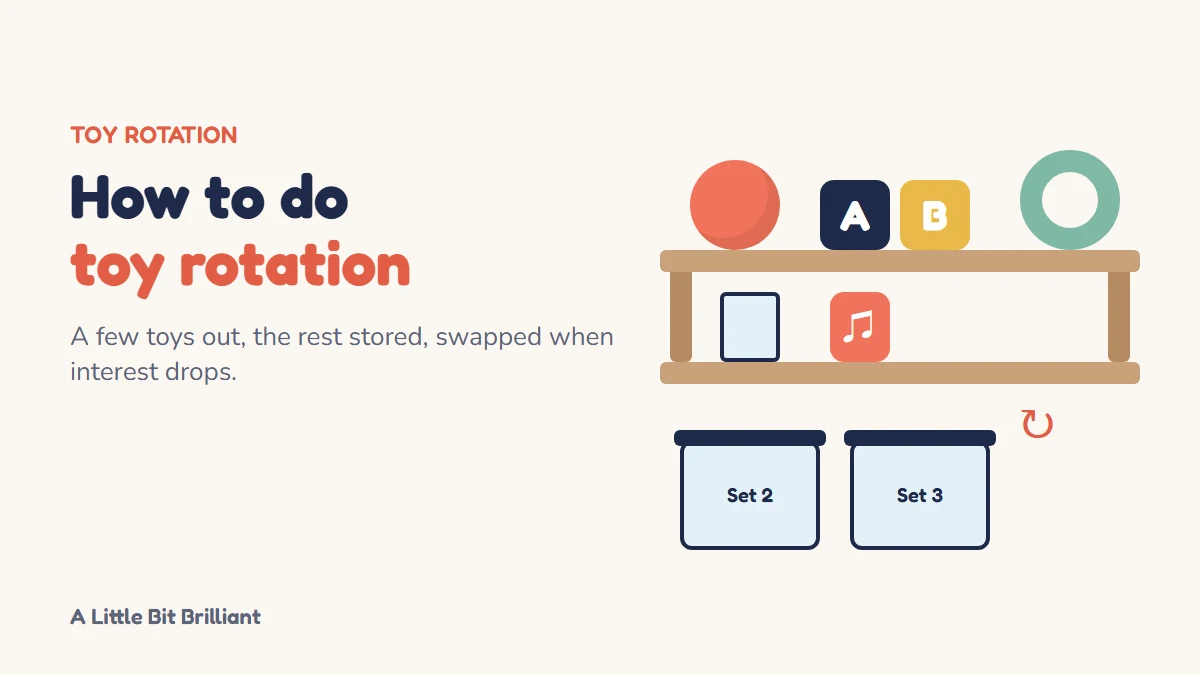
To do toy rotation, keep a small set of toys out where your child can reach them and store the rest out of sight. When your child loses interest in a toy, or after a week or a few, swap a few toys for ones from storage. We found no official number or schedule from the AAP, CDC or CPSC. Parenting and Montessori sources we read suggest putting out about 5 to 12 toys and swapping every 1 to 3 weeks.
Below: what toy rotation is, what the research actually found, a step-by-step setup, how many toys and how often, how to do it with a baby, and a safety check to do every time toys come out of storage. Our sources are listed at the end.

What is toy rotation?
Collaborative for Children, a Houston early-education nonprofit, describes toy rotation as a practice that “limits the number of toys available at one time while storing the rest out of sight.” Your child doesn’t own fewer toys. They just see fewer at once, and the stored ones come back later.
HealthLink BC, a British Columbia government health service, gives parents of babies this tip: “Put some of your baby’s toys away for a time and then reintroduce them. This will keep your baby interested in toys they’ve gotten used to.”
Does toy rotation work? What the research found
We couldn’t find a study that tested toy rotation itself, meaning swapping toys at home over weeks and measuring the results. What exists are studies on how many toys are in the room during one play session.
The toddler study (University of Toledo, 2018). Researchers Dauch, Imwalle, Ocasio and Metz watched 36 toddlers, 18 to 30 months old, play in a lab playroom twice: once with 4 toys and once with 16. With fewer toys, the toddlers had “longer durations of toy play, and played with toys in a greater variety of ways.” The University of Toledo’s news release says the team charted how many times a toddler picked up a toy, how long they played with it, and how many ways they played with it. The toys didn’t belong to the children, and in a 2025 TODAY article, lead researcher Dr. Alexia Metz cautioned that her research doesn’t perfectly translate to the average home.
Metz’s own advice for families: “Save some for later and swap them out. If they have a chance to explore a few toys at a time, they might have a richer experience.”
The baby study (2021). Koşkulu and colleagues watched 12-month-old babies play with their mothers for five minutes, with either 5 toys or 12. In the 5-toy group, moments when mother and baby focused on the same toy together “lasted longer.” The authors concluded that “mothers and infants establish higher-quality joint attention with fewer toys.” This study looked at shared attention between parent and baby. It didn’t measure language or development.
So the honest answer: fewer toys at once helped toddlers stay with a toy longer in a lab, and moments when babies and mothers focused on the same toy lasted longer, though they happened less often. Rotation is a simple way to keep fewer toys out without getting rid of any.
How to do toy rotation, step by step
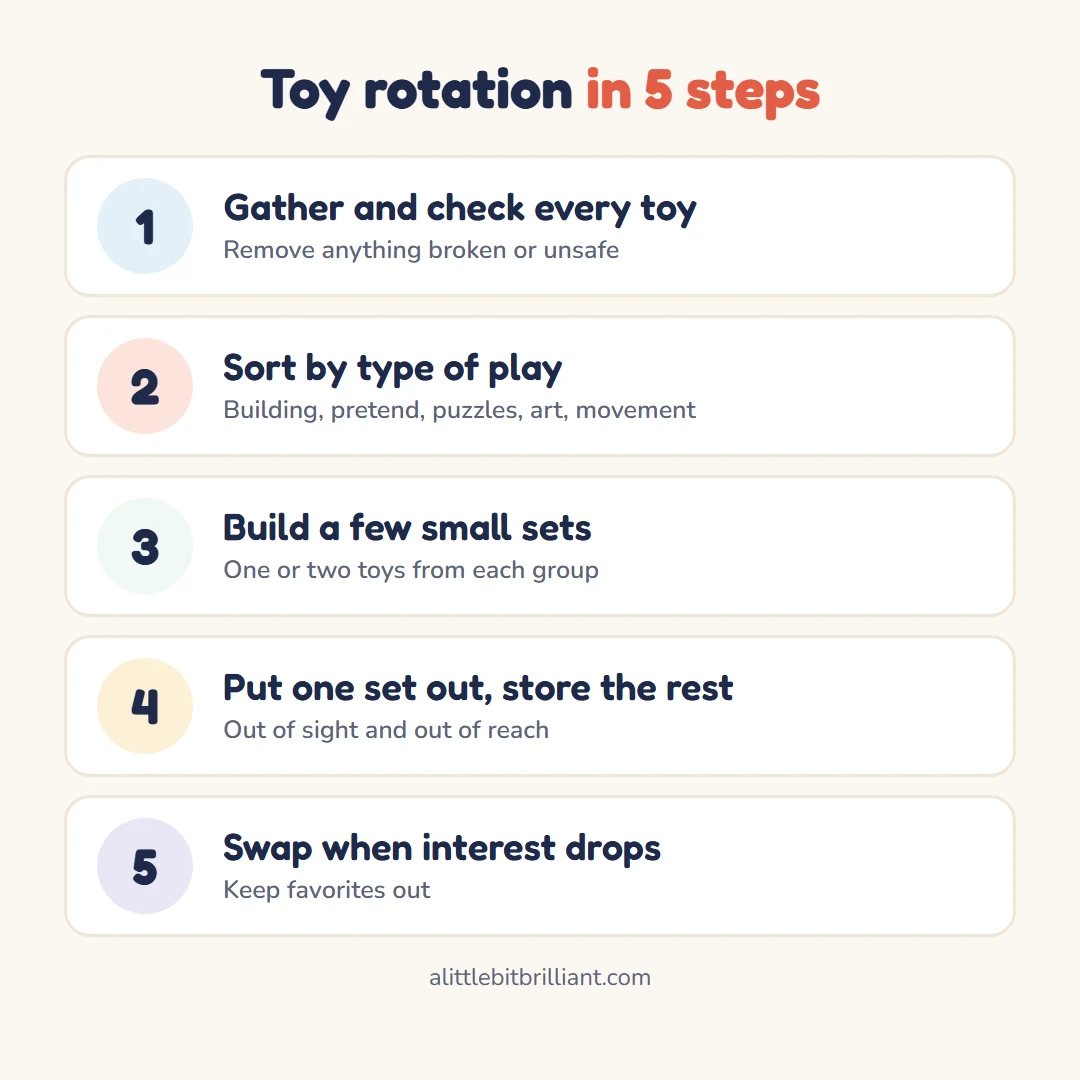
- Gather the toys and check each one. Collaborative for Children suggests starting by “removing anything broken, unsafe, or no longer age‑appropriate.” The CPSC says “A damaged or dangerous toy should be thrown away or repaired immediately.” Use the safety check below.
- Sort by type of play. Group toys “loosely by type, such as building toys, pretend play, puzzles, art materials, and movement toys” (Collaborative for Children). For babies, Virtual Lab School, a child-care training program, lists materials for fine-motor skills (“grasping, turning, poking, shaking”), gross-motor skills (“climbing, balancing, pulling, pushing”) and cause and effect.
- Build a few small sets. Pick one or two toys from each group so every set has a mix. Starfish Therapies, a pediatric therapy clinic, describes choosing “1 or 2 from each of these piles.”
- Put one set out and store the rest. “The rest are stored out of sight but easy to access” (Collaborative for Children). For the set that’s out, the AAP suggests open shelves instead of a toy box: “If possible, store toys on open shelves so that your child can get them easily.”
- Watch, then swap. Swap toys when your child loses interest (see the signs below). Hello Charlie, a toy seller, suggests you “Swap one to three choices rather than replacing the whole shelf.”
A tip from Lovevery’s blog: “Try to do the rotation when your child is not around, keeping favourites in the same place, so the change doesn’t feel sudden.”
How many toys should be out in a toy rotation?
We found no study that sets one right number. The Toledo study compared 4 toys with 16 in a lab. It didn’t test 6, 8 or 10. Here is what different sources suggest, and who says it:
| Source | Toys out at once | Who it’s for |
|---|---|---|
| Montessori Foundation | 5 to 8 per shelf | Young children at home |
| Montessori teacher quoted by Romper | 6 to 10 | Children at home |
| Hello Charlie (toy seller) | 6 to 10 choices | Toddlers |
| Lovevery blog (How We Montessori) | About 9 to 12 items | Toddlers |
| ChildCareEd (child-care training) | 2 to 4 per play area | Toddler classrooms |
Two rules make counting easier. Hello Charlie counts “A basket of blocks” as “one choice, not 30 toys,” and says “Books and a comfort item can sit outside the count.” The Montessori teacher quoted by Romper adds: “The exact number is not specified in any Montessori literature — we use observation to see if the child is overwhelmed or needs more.”
ChildCareEd gives a simple test for toddler rooms: if children are dumping bins and running around, there may be too much out. If they look bored, there may be too little out, or it may be time to rotate.
How often should you rotate toys?
We found no official schedule. Common advice:
- Collaborative for Children: “Most families rotate toys every one to three weeks, but the best schedule is the one you can maintain consistently.”
- Montessori Foundation: “Every 2–3 weeks, observe your child.”
- Lovevery’s experts: “There’s no one-size-fits-all schedule or guideline for rotating toys. Following your baby’s cues is your best move.”
Watching your child works better than a calendar. Virtual Lab School tells infant and toddler caregivers to rotate materials when children “appear to have lost interest,” when materials are “too easy or too hard,” or when they “have been used for some time,” unless children “are still interested and actively using them.”
Keep favorites out
Rotation doesn’t mean taking away what your child loves. Starfish Therapies says: “If your child has an absolute favorite, must be present toy or two – leave those out through all of the rotations.” Happiest Baby adds that any “lovey” item “that gets slept with” should stay year-round. And if your child asks for a stored toy, the Montessori Foundation’s advice is: “give it to them!”
How to do toy rotation for babies
You can start simple. HealthLink BC’s tip (put some toys away, then bring them back) is written for parents of babies. Hello Charlie says rotation “becomes more practical once a baby is mobile and clearly revisits toys.”
- Young babies: HealthLink BC says “Between 3 and 6 months, babies seem to like toys that they can easily handle.”
- Around 8 to 12 months: “when they’re able to pick up objects, babies may love to play with blocks” (HealthLink BC).
- Household items count. HealthLink BC says objects “like a spoon or measuring cups, can serve as toys as long as they can’t injure or be swallowed by the baby.”
- Short play is normal. Lovevery notes “a “long” play session for a baby may be just a couple of minutes and they may play longer when you participate.”
Babies explore with their mouths: the CDC lists “Puts things in her mouth to explore them” as a 6-month milestone. The AAP says to make sure all toys and parts are larger than your child’s mouth to prevent choking. For what to expect month by month, see when babies start playing with toys.
Safety check every time toys come out of storage
Rotation day is a good time to look each toy over. Use this list from the CPSC, the AAP and Seattle Children’s Hospital:
- Broken or worn parts. The CPSC says to “Check all toys periodically for breakage and potential hazards.” Seattle Children’s says to “Watch for splinters or sharp edges on wooden toys.”
- Small parts for children 3 and under. Seattle Children’s says to “make sure that toys and parts cannot fit inside an empty toilet paper tube,” and to “Check stuffed animals for eyes, noses and parts that can come off.”
- Battery doors. Seattle Children’s says “Make sure all battery-operated toys have a cover that closes with screws.” For button batteries, the CPSC says: “If the battery compartment is damaged, replace the product as soon as possible, repair or dispose of the product.”
- Recalls. The AAP says “Toys that are recalled should be removed right away.” You can search recalls and sign up for recall emails at cpsc.gov/Recalls.
- Older siblings’ toys. The CPSC says to “Keep toys designed for older children out of the hands of little ones.”
- Crib toys. The AAP says hanging crib toys such as mobiles and crib gyms “must be removed when your baby first begins to push up on their hands and knees, or when the baby is 5 months old — whichever comes first.”
Clean toys and dry them before you store them
Clean toys before they go into a bin, so you aren’t storing dirt or germs for weeks. If you’re washing by hand toys that won’t be damaged by water, NYC Health’s toy cleaning sheet for child care programs says: “Scrub in warm, soapy water,” then “Rinse with clean water. Air-dry or dry with a clean cloth.” The CDC’s child care cleaning guidance says to “allow to air dry completely before storing or using.”
Toys with batteries, wooden toys and plush toys need different care. See our guides on how to clean baby toys, how to clean bath toys, how to clean stuffed animals and what to clean baby toys with.
Where to store the toys you rotate out
- Keep them out of reach. Hello Charlie notes storage “must be inaccessible to young children if it contains older-sibling toys, small parts, magnets, batteries or heavy tubs.”
- Bins without lids for the play area. Seattle Children’s says “use baskets or boxes without lids to store toys.”
- If you use a toy chest, the CPSC says to use “a lid that will stay open in any position to which it is raised” and to “be sure there are ventilation holes for fresh air.” The AAP adds: “Be sure the lid doesn’t latch.”
More ideas for the storage side: how to store baby toys.
FAQ
How often should you rotate toys?
We found no official schedule. Collaborative for Children says most families rotate every one to three weeks, and the Montessori Foundation suggests checking every 2 to 3 weeks. Swap sooner if your child has lost interest, and leave a toy out if they still use it.
How many toys per toy rotation?
We found no study that sets a number. The University of Toledo study compared 4 toys with 16 in a lab. Parenting and Montessori sources suggest about 5 to 12 toys out at once, with a basket of blocks counted as one choice.
What age to start toy rotation?
You can start with a baby. HealthLink BC tells parents of babies to put some toys away for a time and then bring them back. Rotation often gets easier once a baby can move and go after toys.
Does toy rotation work?
We couldn't find a study that tested rotation itself. A 2018 study found toddlers played longer with each toy and in more ways when 4 toys were out instead of 16. A 2021 study found that with 5 toys instead of 12, moments when babies and mothers focused on the same toy lasted longer, though they happened less often.
Is toy rotation Montessori?
The Montessori Foundation (montessori.org) recommends fewer, better-chosen toys rotated on a schedule. A Montessori teacher quoted by Romper says the exact number of toys is not specified in any Montessori literature.
What are toy rotation categories?
Common groups are building toys, pretend play, puzzles, art materials and movement toys. For babies, group toys for grasping and shaking, for moving and pushing, and for cause and effect. Pick one or two from each group for every set.
Sources
- Dauch C, Imwalle M, Ocasio B, Metz AE. The influence of the number of toys in the environment on toddlers’ play. Infant Behavior and Development. 2018: pubmed.ncbi.nlm.nih.gov
- University of Toledo News, Fewer toys lead to richer play experiences (Dec 18, 2017): news.utoledo.edu
- BPS Research Digest, An over-abundance of toys may stifle toddler creativity (Apr 9, 2018): bps.org.uk
- NBC New York / TODAY, An expert shares how many toys your child should have (Apr 23, 2025): nbcnewyork.com
- Koşkulu S, Küntay AC, Liszkowski U, Uzundag BA. Number and type of toys affect joint attention of mothers and infants. Infant Behavior and Development. 2021: pubmed.ncbi.nlm.nih.gov
- HealthLink BC, Stimulate Your Baby’s Learning: healthlinkbc.ca
- Collaborative for Children, Toy Rotation for Focused Play at Home (Mar 17, 2026): collabforchildren.org
- Virtual Lab School, Selecting Materials (infants and toddlers): virtuallabschool.org
- Starfish Therapies, Toy Rotation (Jul 2020): starfishtherapies.com
- Montessori Foundation (montessori.org), toy rotation post (Jul 25, 2026): montessori.org
- Romper, Here’s How Montessori Experts Decide How Many Toys A Kid Actually Needs (May 17, 2019): romper.com
- Hello Charlie, Toy rotation for toddlers (Aug 11, 2026): hellocharlie.com.au
- Lovevery blog, Why you should rotate Montessori toys for toddlers (May 29, 2020): blog.lovevery.eu
- Lovevery blog, How often should I give my baby new toys to play with? (Apr 11, 2024): blog.lovevery.com
- ChildCareEd, Toy rotation for toddlers: childcareed.com
- Happiest Baby, Spark Your Tot’s Imagination With a Toy Rotation: happiestbaby.com
- CDC, Important Milestones: Your Baby By Six Months: cdc.gov
- CDC, How To Clean and Disinfect Early Care and Education Settings: cdc.gov
- NYC Health, Toy cleaning one-pager: nyc.gov PDF
- CPSC, For Kids’ Sake: Think Toy Safety (Pub. 281): cpsc.gov PDF
- CPSC, Recalls: cpsc.gov
- CPSC, Reese’s Law button battery standard (Sep 11, 2023): cpsc.gov
- AAP HealthyChildren, Toy Box Safety: healthychildren.org
- AAP HealthyChildren, How to Buy Safe Toys: A Parent’s Guide: healthychildren.org
- Seattle Children’s Hospital, Toy Safety: seattlechildrens.org
Start small: put out a handful of toys today, box up the rest, and let your child show you when it’s time to swap.